Understanding the Blastocyst Grading Scale: What Your Embryo Grade Really Means
Quick Summary
The blastocyst grading scale is a three-part score that embryologists use to judge a Day 5 to 7 embryo:
- A number (1 to 6) shows how expanded or developed the blastocyst is.
- The first letter grades the inner cell mass, which later forms the baby.
- The second letter grades the trophectoderm, which later forms the placenta.
A higher number and letters closer to “A” usually mean better implantation chances. Lower-grade blastocysts can still lead to healthy births.
What Is a Blastocyst?
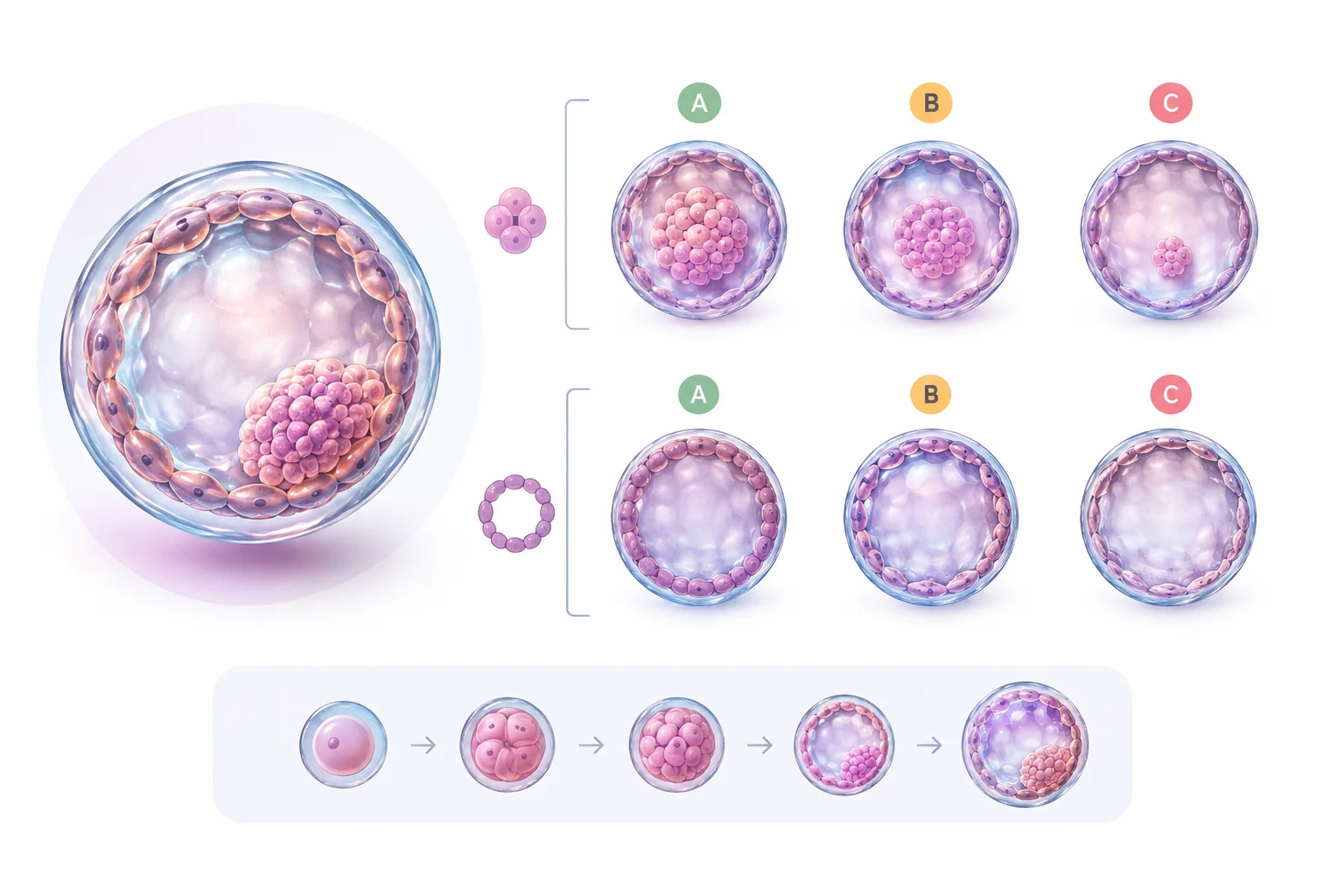
A blastocyst is an embryo about 5 to 7 days after fertilisation. By this stage it has two distinct parts:
- Inner cell mass (ICM): a small cluster of cells that becomes the baby
- Trophectoderm (TE): an outer layer of cells that becomes the placenta
- Blastocoel: a fluid-filled cavity in the centre
Many IVF clinics grow embryos to this stage before transfer or freezing, because it gives the embryologist more information about how each embryo is developing.
How Does the Blastocyst Grading Scale Work?
Most labs use a system first described by Gardner and Schoolcraft in 1999. The 2011 Istanbul Consensus adopted this three-part approach for blastocysts, with later modifications.
Part 1: Expansion Stage (the number)
|
Grade |
Stage |
What it means |
|
1 |
Early blastocyst |
Cavity is less than half the embryo |
|
2 |
Blastocyst |
Cavity is half or more of the embryo |
|
3 |
Full blastocyst |
Cavity fills the embryo |
|
4 |
Expanded |
Embryo has grown larger and its shell is thinning |
|
5 |
Hatching |
Embryo is starting to break out of its shell |
|
6 |
Hatched |
Embryo has fully left its shell |
Part 2: Inner Cell Mass (first letter)
|
Grade |
Appearance |
|
A |
Many cells, tightly packed |
|
B |
Several cells, loosely grouped |
|
C |
Very few cells |
|
D (added in 2025) |
Degenerating cells or no clear inner cell mass |
Part 3: Trophectoderm (second letter)
|
Grade |
Appearance |
|
A |
Many cells forming a smooth, even layer |
|
B |
Fewer cells forming a looser layer |
|
C |
Very few large cells |
|
D (added in 2025) |
Degenerating cells |
Note: Many labs give ICM and TE letters only once the blastocyst reaches stage 3 or higher. Practice varies from lab to lab, so ask your clinic how they grade.
How to Read Your Embryo Grade: Worked Examples
|
Grade |
Plain-language meaning |
|
4AA |
Expanded, with an excellent inner cell mass and trophectoderm |
|
5AB |
Hatching, excellent inner cell mass, good trophectoderm |
|
3BB |
Full blastocyst, good but less compact cell layers |
|
4BC |
Expanded, fair inner cell mass, fewer trophectoderm cells |
|
3CC |
Full blastocyst, few cells in both layers |
Read the grade in this order: number first, then inner cell mass, then trophectoderm.
What Changed in 2025? (Recent Update)
In 2025, ESHRE and Alpha Scientists in Reproductive Medicine published an updated Istanbul Consensus, which replaced the 2011 version. The update was needed after more than a decade and after time-lapse imaging became part of embryo culture and assessment.
Key changes for patients:
- The update recognises that Day 7 blastocysts and blastocysts with grade C in the ICM or TE can still be viable and may be suitable for clinical use.
- A new grade D separates embryos with degenerating features or no distinct inner cell mass from poor-quality (grade C) embryos.
- It also adds a detailed table to help labs rank blastocysts for transfer, covering both fresh and frozen embryos.
Source: Coticchio G, et al. Human Reproduction, 2025;40(6):989 to 1035.
Which Part of the Grade Matters Most?
Researchers still disagree, but evidence often points to the trophectoderm and expansion stage.
- A 2011 study by Ahlström and colleagues found that the trophectoderm grade was the strongest indicator of success, while another analysis by Du and colleagues found expansion stage was most closely linked to live birth.
- One explanation: a strong trophectoderm layer may be essential at this stage because it supports hatching and implantation.
What this means for you: A “4AB” and a “4BA” are not always equal. Your embryologist weighs all three parts together, along with your clinical history.
Do Low-Grade Blastocysts Work?
Yes, they can. The chance of success is lower, though.
A large 2023 study in Human Reproduction looked at 10,964 single blastocyst transfers in 10,018 women across 14 clinics in Australia, China, and New Zealand, between 2009 and 2020.
|
Blastocyst quality |
Live birth rate per single transfer |
|
Good grade (AA, AB, BA) |
About 44% |
|
Low grade (a C in ICM or TE) |
About 30% |
|
Very low grade (CC) |
About 14% |
The study found that low-grade blastocysts had lower live birth rates but did not lead to more adverse perinatal outcomes. Preterm birth rates and birthweight were comparable between low-grade and good-grade blastocysts.
Important context: These figures are averages from one population. They are not a prediction for you. Your age, uterine health, and the lab’s own methods all affect your chances. The authors also noted that their retrospective design could not rule out other factors, and that grading differed between operators and labs.
Blastocyst Grading vs Genetic Testing (PGT-A)
|
Blastocyst Grading |
PGT-A |
|
|
What it checks |
How the embryo looks |
Chromosome number |
|
Method |
Microscope or time-lapse camera |
A few cells biopsied from the trophectoderm |
|
Invasive? |
No |
Yes (biopsy) |
|
Tells you chromosomal health? |
No |
Gives an estimate, with limits |
|
Used for |
Ranking embryos |
Screening for chromosomal abnormalities in selected cases |
A beautiful-looking embryo can have chromosomal problems. A lower-grade embryo can be chromosomally normal. PGT-A is not recommended for everyone, so discuss it with your doctor before deciding.
Day 5 vs Day 6 vs Day 7 Blastocysts
- Day 5: The most common timing for blastocyst transfer or freezing.
- Day 6: Slower-growing, but many still lead to pregnancy. Some studies report slightly lower success than Day 5.
- Day 7: Once often discarded. The 2025 consensus now recognises them as potentially viable.
The day your embryo reached the blastocyst stage is part of the full picture. Ask your clinic whether your report shows it.
Limitations of Blastocyst Grading
- Subjective: Two embryologists can grade the same embryo differently.
- A snapshot: Embryos change hour by hour, and a single look may miss that.
- Not a guarantee: Grading ranks embryos. It does not predict outcomes with certainty.
- No genetic information: Appearance does not confirm chromosomal health.
- Uterus matters too: Endometrial receptivity, age, and health conditions affect results.
How Your Embryologist Uses the Grade: Step by Step
- Embryos are cultured and checked on Day 5, 6, and sometimes 7.
- Each blastocyst is graded on expansion, ICM, and TE.
- Embryos are ranked, usually starting with the most developed ones with better ICM and TE grades.
- The top-ranked embryo is transferred, or all suitable embryos are frozen.
- Remaining embryos are frozen based on your lab’s criteria.
- Your doctor explains the grades and plans the next step with you.
Questions to Ask Your Fertility Doctor
- What grade is each of my embryos, and on which day?
- Why did you choose this embryo for transfer?
- Does your lab grade D or freeze grade C embryos?
- Should I consider PGT-A in my situation?
- How do my age and history change what these grades mean for me?
When Should You Talk to a Specialist?
Speak to your fertility specialist if:
- You received only low-grade embryos and feel unsure about next steps
- You have had repeated failed transfers with good-grade embryos
- Your embryos stopped developing before Day 5
- You are deciding whether to transfer, freeze, or discard an embryo
If you are going through IVF in Pune and want your embryo report explained clearly, you can consult Dr. Supriya Puranik, IVF specialist in Pune. A personal consultation can put your grades in the context of your own history.
Frequently Asked Questions
What is a good blastocyst grade?
Grades of 3 or higher with AA, AB, or BA letters are usually considered good quality. BB is often called moderate or fair.
What does 4AA mean?
An expanded blastocyst with an excellent inner cell mass and an excellent trophectoderm. It is one of the highest grades.
Can a 3CC or 4CC embryo result in pregnancy?
Yes, but less often. In one large study, very low-grade (CC) blastocysts had about a 14% live birth rate per single transfer.
Is 3BB a good embryo?
3BB is a fair-to-good blastocyst. Many labs consider it suitable for transfer or freezing, and pregnancies from BB embryos are common.
Which is more important, ICM or TE?
Several studies suggest the trophectoderm grade and expansion stage predict live birth more strongly than the ICM. Evidence is not fully settled.
Does a low embryo grade mean my baby will have problems?
Current evidence suggests no. The 2023 multicentre study found no increase in preterm birth or birthweight problems with low-grade blastocysts.

-
About Author
Dr. Supriya Puranik
Gynaecologist & IVF Specialist
MMC -072514 (1993)
Dr. Supriya Puranik, a renowned gynaecologist and infertility expert, leads the IVF & Gynaecology department at Sahyadri Hospitals Momstory in Shivaji Nagar, Pune. She is committed to helping couples overcome infertility challenges.
Appointment On Call