IVF Injections: What They Are, How They Work and What to Expect

Quick Answer
- What they do: grow eggs, stop early ovulation, trigger egg maturity and support the womb lining.
- Main type: FSH (follicle stimulating hormone) injections. You have daily injections of FSH for 10 to 14 days.
- Final injection: a trigger shot. If your stimulation treatment works as planned, the clinic gives a final injection to help the eggs fully mature, then schedules egg collection about 36 hours later.
- Main risk: OHSS (ovarian hyperstimulation syndrome). Most cases are mild.
What Are IVF Injections?
Your body naturally produces follicle stimulating hormone (FSH). In a natural cycle, this hormone makes only one follicle grow and release an egg. FSH injections stimulate the ovaries to produce more than one egg.
The medicines that do this are called gonadotropins. Gonadotropins are fertility medications given by injection that contain FSH alone or combined with luteinizing hormone (LH).
Types of IVF Injections
| Injection type | What it does | When it is used |
| Stimulation (FSH, or FSH with LH/hMG) | Grows several eggs | Daily, from early in the cycle, for about 10 to 14 days |
| GnRH antagonist | Stops you ovulating too early | Added partway through stimulation |
| GnRH agonist (long protocol) | Switches off your natural cycle first | Before stimulation, in some protocols |
| Trigger shot (hCG or GnRH agonist) | Final egg maturation | Once, at a precise time before egg collection |
| Progesterone | Supports the womb lining | After egg collection or embryo transfer |
About suppression and route.
- The medicine that suppresses your natural cycle is given either as a daily injection you learn to give yourself, or as a nasal spray, usually for about 2 weeks.
- Gonadotropins are made by several different drug companies. All may be given into the muscle, and some can also be given under the skin.
- Most modern stimulation pens go under the skin, in the belly area.
How Does the IVF Injection Process Work? (Step by Step)

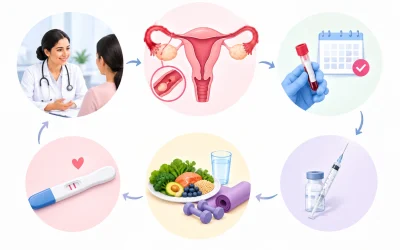
- Baseline check. On day 2 or 3 of your period, you have a scan and sometimes blood tests. Your doctor confirms it is safe to start.
- Stimulation injections. You take daily FSH injections at roughly the same time each day.
- Monitoring. Scans and blood tests every few days track follicle growth. Your dose may be adjusted.
- Blocking early ovulation. An antagonist or agonist injection stops the eggs being released before collection.
- Trigger shot. When the follicles reach the right size, you take the trigger injection at the exact time your clinic gives you.
- Egg collection. This is done about 36 hours after the trigger, under sedation.
- Luteal support. After egg collection, you are given hormone medicines to prepare the lining of your womb to receive the embryo. These may be injections, vaginal gels or pessaries.
Simple timeline
| Phase | Typical duration |
| Stimulation injections | About 10 to 14 days |
| Trigger to egg collection | About 36 hours |
| Progesterone support | Until the pregnancy test, and longer if pregnant (as advised) |
Visual suggestion: a horizontal timeline graphic of these phases. Do not add numbers beyond what is shown here.
How to Give Yourself an IVF Injection
- Wash your hands. Check the medicine name, dose and expiry date.
- Clean the skin on your lower belly, about two finger-widths away from the belly button.
- Pinch a fold of skin gently. Insert the needle as you were shown.
- Inject slowly, wait a few seconds, then remove the needle.
- Throw the needle into a sharps container, not the household bin.
- Change the injection site each day.
Practical tips:
- Set a phone alarm. The trigger shot timing matters most.
- Store medicines as the label says. Some need refrigeration.
- If you miss a dose or inject the wrong amount, call your clinic straight away. Do not double up on your own.
Do IVF Injections Hurt?
Side Effects of IVF Injections
- Bloating and mild tummy discomfort
- Breast tenderness
- Mood changes and tiredness
- Headache
- Soreness or bruising at the injection site
Less common but important: OHSS.
- What it is: OHSS happens when the ovaries over-respond to fertility medication.
- How often: Most cases of OHSS are mild. About 1 in 100 people get mild to moderate OHSS. Very rarely, it can be life-threatening. The latest data from the UK’s Human Fertilisation and Embryology Authority show that severe or critical OHSS is now rare, at around 0.1% of IVF cycles in the UK. Note that this is UK data, not Indian data.
- Who is at higher risk: people with polycystic ovary syndrome (PCOS) or a high number of follicles on ultrasound, those under 30 (especially with other risk factors), and those with a previous history of OHSS.
- When it starts: it usually develops after the trigger injection used before egg collection.
| Benefits | Risks and limitations |
| More eggs collected in one cycle | OHSS, usually mild |
| Better control of timing | Bloating, mood changes, site soreness |
| More embryos to choose from or freeze | Daily routine and frequent clinic visits |
| More eggs does not guarantee a pregnancy |
How Doctors Reduce the Risk of OHSS
- Choose a lower dose or a gentler protocol.
- Use an antagonist protocol with a GnRH agonist trigger instead of hCG.
- Freeze all embryos and transfer later. A frozen embryo transfer cycle does not cause OHSS, because your ovaries are not stimulated.
When Should I Call My Doctor?
Call your clinic the same day if you have:
- Bloating that keeps getting worse
- Rapid weight gain over a day or two
- Passing very little urine
- Nausea or vomiting that does not settle
Seek urgent or emergency care for:
- Breathlessness
- Chest pain
- Severe tummy pain
- Fainting
- A swollen, painful leg
Sudden severe abdominal pain can also signal ovarian torsion (a twisted ovary), which needs urgent assessment.

IVF Injections vs IUI Medicines
| IVF injections | IUI medicines | |
| Goal | Several eggs for collection | Usually 1 to 2 eggs, released naturally |
| Form | Mostly daily injections | Often tablets; sometimes low-dose injections |
| Monitoring | Frequent scans and blood tests | Fewer scans |
| Egg collection | Yes | No |
Do IVF Injections Affect Future Fertility or Cause Cancer?
Research on long-term cancer risk has been reassuring overall. However, studies continue and the evidence is not complete for every group of patients. Discuss your personal and family history with your doctor.
Key Takeaways
- IVF injections grow several eggs, prevent early ovulation and prepare the womb.
- Stimulation usually lasts about 10 to 14 days, with regular scans.
- The trigger shot timing is critical. Egg collection follows about 36 hours later.
- Most side effects are mild. OHSS is the main risk, and severe OHSS is rare.
- Call your clinic for worsening bloating, breathlessness or severe pain.
FAQs
How many injections are needed for IVF?
Where are IVF injections given?
Can I give IVF injections myself?
What time should I take IVF injections?
What happens if I miss an IVF injection?
Can IVF injections cause weight gain?
Is bleeding after an IVF injection normal?
Can I travel or go to work during IVF injections?
Can I exercise during stimulation?
Do IVF injections affect my periods afterwards?
Are IVF injections safe with PCOS?
Why is the trigger injection timing so important?
Your Title Goes Here

-
About Author
Dr. Supriya Puranik
Gynaecologist & IVF Specialist
MMC -072514 (1993)
Dr. Supriya Puranik, a renowned gynaecologist and infertility expert, leads the IVF & Gynaecology department at Sahyadri Hospitals Momstory in Shivaji Nagar, Pune. She is committed to helping couples overcome infertility challenges.