How to Get Pregnant Fast After an Ectopic Pregnancy
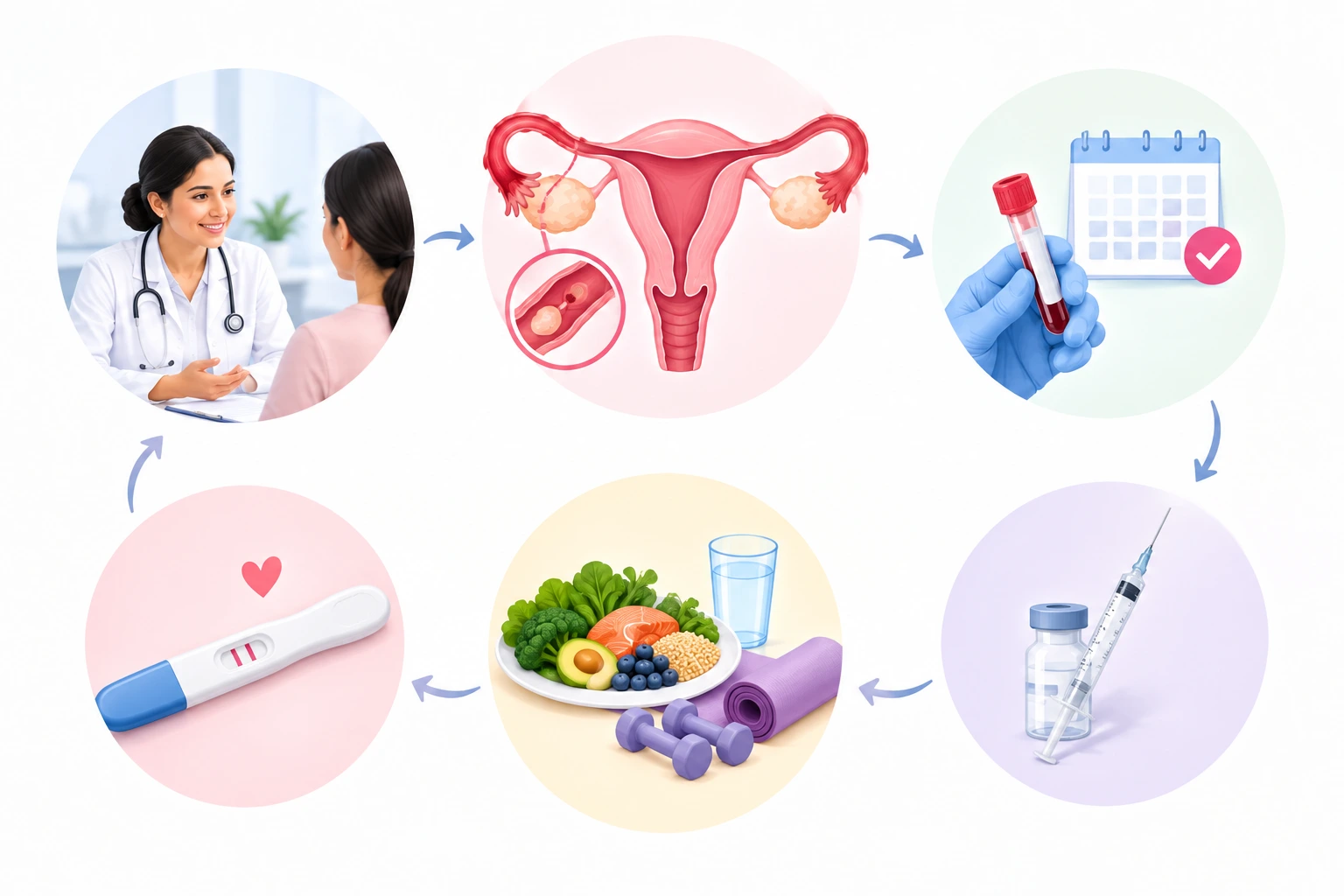
To get pregnant fast after an ectopic pregnancy, most women can start trying once they have physically recovered and feel ready. After methotrexate treatment, wait three months. In Pune or anywhere else, find out the condition of your remaining fallopian tube. In your next pregnancy, get an early beta hCG blood test and a transvaginal scan.
If you are reading this, you may have lost a pregnancy recently, and perhaps a fallopian tube too. Wanting to try again quickly is completely natural. Here is how to do it as safely as possible.
Quick summary:
- After surgery or watchful waiting, you can usually try again once you have recovered.
- After methotrexate, use contraception for three months before trying.
- Most women go on to have a healthy pregnancy.
- Ask for your treatment records, especially the notes on your other tube.
- In your next pregnancy, get a blood test and an early scan as soon as your test is positive.
- See a fertility specialist early if both tubes are affected, or if you don’t conceive within a few months.
How soon can you try to conceive after an ectopic pregnancy?
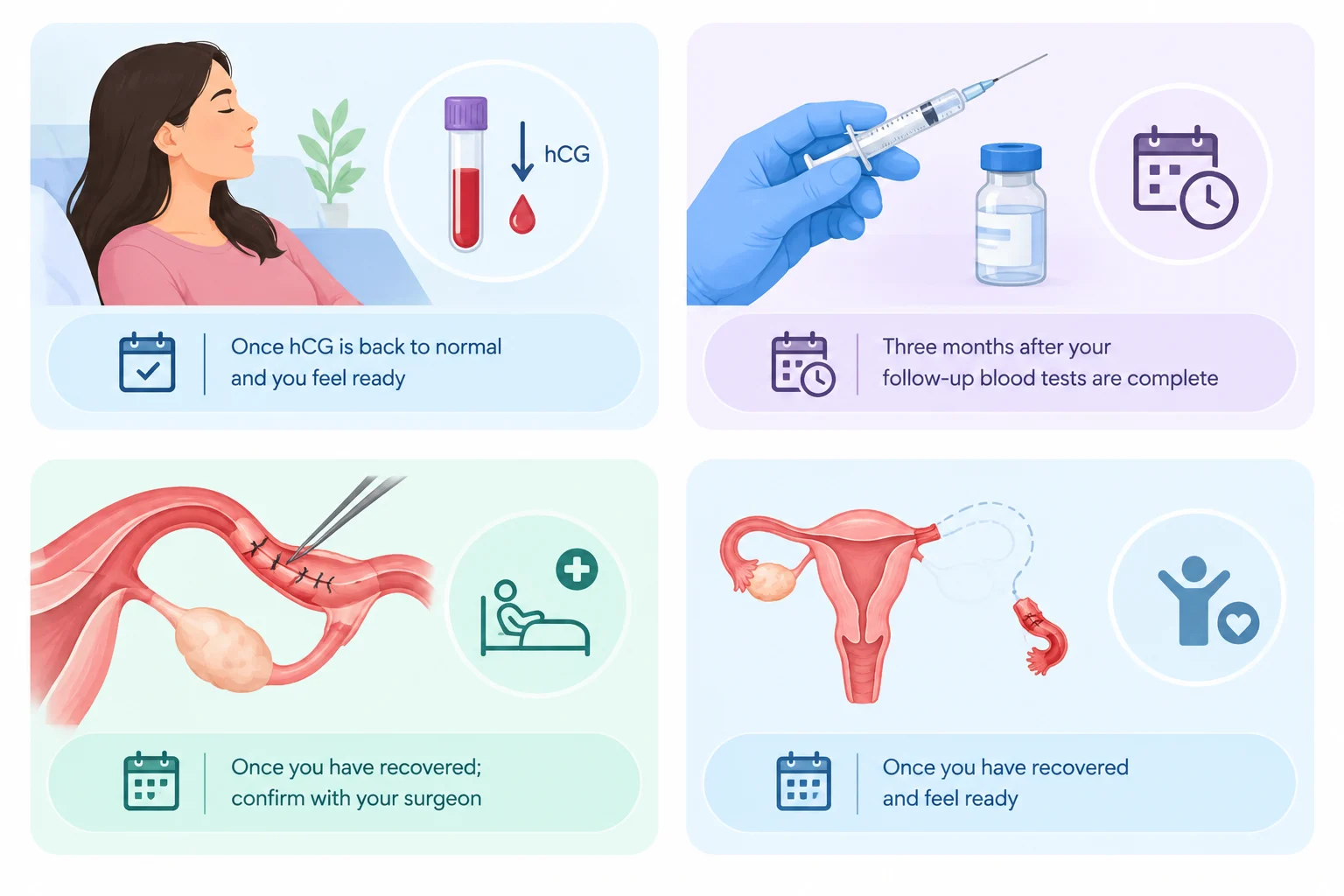
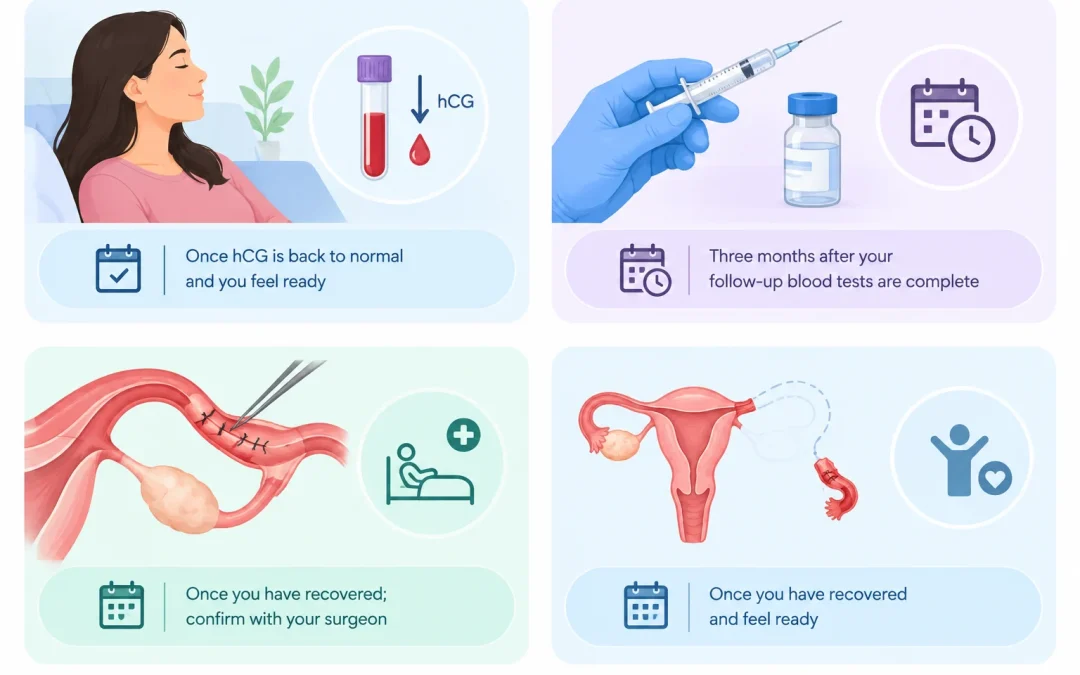
How soon you can try again depends on how your ectopic pregnancy was treated.
|
Treatment you had |
When you can usually try again |
|
Watchful waiting (hCG fell on its own) |
Once hCG is back to normal and you feel ready |
|
Methotrexate injection |
Three months after your follow-up blood tests are complete |
|
Surgery: tube opened and repaired (salpingostomy) |
Once you have recovered; confirm with your surgeon |
|
Surgery: tube removed (salpingectomy) |
Once you have recovered and feel ready |
The three-month wait after methotrexate matters because the medicine can affect a developing pregnancy, so you’ll need reliable contraception during that time. After surgery, there is no good evidence that conceiving soon raises your risk of another ectopic pregnancy.
Many women also wait for one normal period, which helps date the next pregnancy accurately. The right time also depends on how ready you feel emotionally. There’s no rush on that front.
What are your chances of a healthy pregnancy after an ectopic?
Most women have a healthy pregnancy after an ectopic pregnancy. NHS patient information estimates the chance of getting pregnant afterwards at about 70%.
The risk of another ectopic pregnancy is higher than average, though:
- About 10% after one ectopic pregnancy
- About 20 to 30% after two or more
Seen another way, after one ectopic about 9 in 10 future pregnancies will be in the right place.
Your personal chance depends mostly on the health of your remaining tube, your age, and any other fertility factors. Treatment type matters less than people think: NICE notes that future fertility is likely to be the same whether an ectopic was managed with medicine or by waiting.
What should you find out from your treatment records?
Before you start trying again, ask the hospital that treated you for your discharge summary and operation notes. Many women in India leave hospital without knowing these details, and they change your plan.
Ask, or check your records, for:
- Which tube was affected: right or left
- Whether the tube was removed, repaired, or left in place
- What the surgeon saw in your other tube: normal, swollen, or scarred
- Your blood group, and whether you needed an anti-D injection if you are Rh negative [VERIFY: anti-D guidance per NICE NG126]
- Your last hCG result showing it returned to normal
Keep a copy. Show it to any doctor who treats you in your next pregnancy.
Can anything prevent another ectopic pregnancy?
Nothing reliably prevents another ectopic pregnancy, so any product, diet or “tube cleansing” treatment claiming to do so is misleading. The key protection is to detect it early. A problem caught early is easier to treat, often with medicine instead of surgery, and your remaining tube is more likely to be saved.
You can lower general risk by stopping smoking and treating any pelvic infection fully.
When should you see a fertility specialist after an ectopic?
See a fertility specialist early instead of waiting the usual year in these situations:
|
Your situation |
What I usually suggest |
|
Both tubes removed or blocked |
IVF is the main route to pregnancy |
|
Other tube damaged or scarred |
Early assessment, with IVF discussed |
|
Two or more ectopic pregnancies |
Specialist review before trying again |
|
Not pregnant after 6 months of trying |
Tubal test (HSG: an X-ray dye test of the tubes) and fertility review [VERIFY: timeframe with treating doctor] |
|
Age 35 or older |
Earlier review, as age also affects chances |
Does IVF remove the risk of another ectopic? No. IVF places the embryo directly in the uterus, but an ectopic pregnancy can still occur after IVF. You still need early monitoring.
On costs: emergency ectopic treatment is often covered by health insurance, but IVF usually is not. Check your policy wording and ask for a written IVF estimate before you start.
What should you do as soon as your next pregnancy test is positive?
Contact your doctor the same day your home test is positive. Don’t wait for your first routine visit.
- Get a beta hCG blood test. A repeat after 48 hours shows whether levels are rising normally.
- Book a transvaginal (internal) ultrasound at about 6 weeks to confirm the pregnancy is in the uterus.
- Tell every doctor and sonographer that you’ve had an ectopic before.
- Until the scan confirms the location, watch closely for warning signs.
Frequently asked questions
Can I get pregnant naturally with one fallopian tube?
Yes. The remaining tube can pick up an egg from either ovary. If that tube is healthy, many women conceive naturally.
Will my next pregnancy be high risk all the way through?
No. The added risk is mainly about where the pregnancy implants. Once an early scan confirms it is in the uterus, care usually continues as normal.
Is it normal to feel anxious about trying again?
Yes. Fear of another ectopic pregnancy is very common. Talking to a counsellor, or planning an early scan in advance, often helps.
Does an ectopic pregnancy mean I will need IVF?
Not usually. Most women with at least one healthy tube conceive naturally. IVF is mainly for those whose tubes are blocked or removed, or who have other fertility problems.
Can my husband's or partner's tests help?
Yes. If you’re seeing a specialist, a semen analysis should be done at the same time so no time is lost.

-
About Author
Dr. Supriya Puranik
Gynaecologist & IVF Specialist
MMC -072514 (1993)
Dr. Supriya Puranik, a renowned gynaecologist and infertility expert, leads the IVF & Gynaecology department at Sahyadri Hospitals Momstory in Shivaji Nagar, Pune. She is committed to helping couples overcome infertility challenges.