
Your Pregnancy Test After IUI: A Complete Guide
Summary
After an Intrauterine Insemination (IUI), you should wait exactly 14 days before taking a pregnancy test.
Testing too early can lead to a false positive due to the hCG hormone from your trigger shot, or a false negative because your body has not yet produced enough natural hCG.
For the most accurate results, a beta hCG blood test at your fertility clinic is always recommended over a home urine test.
Hello, I am Dr Supriya Puranik. If you are reading this, you are likely in the middle of what we call the “two-week wait” after your IUI procedure.
I know exactly how heavy this time can feel. You are constantly analysing every twinge in your body, wondering if it worked, and fighting the urge to take a pregnancy test every time you visit the bathroom.
I see this anxiety in my patients every single day. The fertility journey is physically demanding, but the emotional toll is often the hardest part. You have done everything right so far. Now, you just want answers.
Today, I want to sit down with you—virtually—and explain exactly what is happening in your body right now. We will discuss when you should test, why patience is your best friend, and what your results actually mean.
What exactly happens after your IUI procedure?
To understand the testing timeline, we first need to look at what happens inside your body after you leave the clinic.
During your Intrauterine Insemination (IUI), we place highly concentrated, active sperm directly into your uterus. This happens right around the time you release an egg.
Once we complete the procedure, the sperm still needs to swim to the fallopian tube to meet the egg.
If fertilisation occurs, the resulting embryo then travels down the fallopian tube to your uterus. This journey takes several days.
After reaching the uterus, the embryo must implant itself into the uterine lining. Implantation usually happens between six to ten days after ovulation.
Only after successful implantation does your body begin to produce the pregnancy hormone, human chorionic gonadotropin (hCG). This is the exact hormone that pregnancy tests look for.
Why is the two-week wait so important?
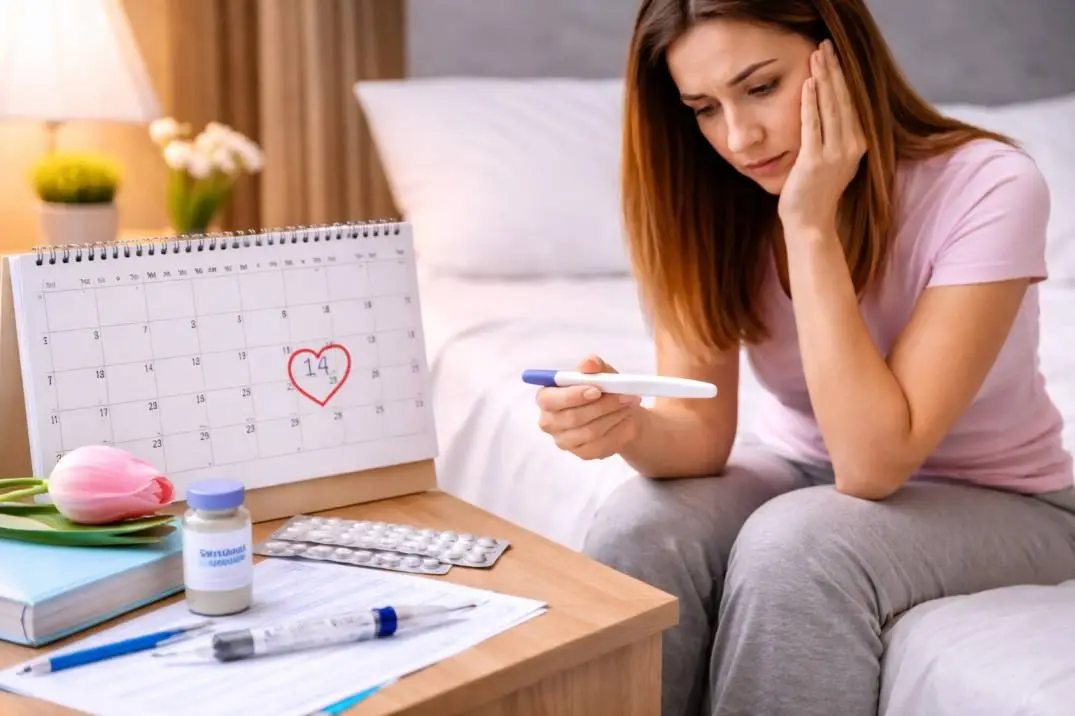
You will hear fertility doctors talk about the two-week wait constantly. I know it sounds like a frustrating delay, but this 14-day timeline is biologically necessary.
Before your IUI, you likely received a “trigger shot” to induce ovulation. This injection contains synthetic hCG. Yes, that is the exact same hormone produced during pregnancy.
This synthetic hormone stays in your system for up to 14 days.
If you take a home pregnancy test while the trigger shot is still in your bloodstream, the test will detect the synthetic hCG. It cannot tell the difference between the injection and a real pregnancy.
Waiting two full weeks ensures that the medication has completely left your body.
When should you take a pregnancy test after IUI?
I always tell my patients to wait exactly 14 days post-IUI before taking any pregnancy test.
I understand the temptation to test at day ten or eleven, but doing so often causes unnecessary heartache and confusion.
When day 14 arrives, you have two options. The first is a standard home urine test.
If you choose this route, always use your first morning urine. This is when your natural hCG levels are at their most concentrated.
However, the second and far better option is a beta hCG blood test. I always encourage my patients to come back to the clinic for this blood draw.
Blood tests are incredibly sensitive and can detect even the smallest trace of hCG.
Furthermore, they give us a specific number, allowing us to track whether the hormone levels are rising appropriately over the following days.
Can you get a false positive pregnancy test?
Yes, false positives are entirely possible during fertility treatments, and they are incredibly painful to experience.
As we discussed, the most common culprit is testing too early while the ovulation trigger shot is still active in your system.
Another reason for a false positive is a chemical pregnancy.
This occurs when an embryo implants just long enough to produce a small amount of hCG, but stops developing shortly after.
Your home test might show a faint positive line, but a follow-up test a few days later will be negative.
This emotional rollercoaster is exactly why I urge you to rely on clinical blood tests rather than stocking up on home testing kits.
We want to give you certainty, not false hope.
What if you get a negative result?
If you wait the full 14 days and receive a negative result, it is natural to feel devastated. Allow yourself to feel that grief.
The fertility process takes immense courage, and every setback hurts.
However, a negative test does not mean you will never become a mother.
It simply means this specific cycle did not result in a pregnancy. Sometimes, the timing is slightly off, or the egg and sperm simply did not combine as we hoped.
If your test is negative, we ask you to stop any progesterone supplements you might be taking.
Your period should start within a few days. Once it does, we will schedule a consultation.
We will review the cycle, look at how your body responded to the medications, and adjust our strategy for the next round. You are never alone in this process.
What are the early signs of pregnancy to watch for?
During the two-week wait, you will likely notice several physical changes. Many women experience cramping, breast tenderness, fatigue, and mild bloating.
Here is the frustrating truth: the early signs of pregnancy are completely identical to premenstrual symptoms.
Furthermore, the progesterone supplements we often prescribe after IUI cause these exact same side effects.
You might experience light spotting, which could be implantation bleeding, but it could also simply be your cervix reacting to the IUI catheter.
Because these symptoms are so unreliable, I advise you to try not to over-analyse them. Only a positive hCG test can confirm your pregnancy. Try to rest, eat nourishing foods, and find gentle distractions during the wait.
Must Read : How Long Does It Take to Get Pregnant with IUI?
How can we support your fertility journey?
Navigating fertility treatments is not something you should ever have to do blindly.
You need a medical team that understands the science of reproduction and respects the deep emotional weight you are carrying.
Whether you are preparing for your first IUI, waiting for your test results, or exploring alternative options after an unsuccessful cycle, we are here to guide you.
Every woman’s body is entirely unique, which means your treatment plan must be completely personalised.
If you have questions about your recent IUI, or if you are ready to take the next step in growing your family, I invite you to reach out.
Book a consultation with our clinic today.
Let us sit down together, review your medical history, and create a clear, compassionate path forward. You do not have to walk this path alone.
Still feeling unsure? You’re not alone in this journey.
Frequently Asked Questions (FAQs)
1. Can I do daily pregnancy tests after IUI to track results?
It’s not recommended. Testing daily can create confusion due to fluctuating hormone levels and may increase anxiety without providing reliable information.
2. Does implantation always happen after IUI?
No. Even if fertilisation occurs, implantation may not happen due to various factors like embryo quality or uterine receptivity.
3. Can stress affect IUI success or pregnancy test results?
Stress does not directly change test results, but high stress levels can impact overall hormonal balance and well-being during the cycle.
4. Should I avoid physical activity after IUI?
Light activities are safe, but avoid heavy exercise or strenuous workouts for a few days after the procedure.
5. Can diet impact implantation success after IUI?
A balanced diet rich in protein, iron, and antioxidants supports overall reproductive health, though it does not guarantee implantation.
6. Is it normal to have no symptoms after IUI?
Yes. Many women experience no noticeable symptoms and still have a successful pregnancy.
7. Can I travel after undergoing IUI?
Yes, short-distance travel is usually safe. However, avoid long or exhausting journeys immediately after the procedure unless your doctor approves.
8. Does age affect the accuracy of pregnancy tests after IUI?
No, test accuracy is not affected by age, but age can influence overall fertility and success rates.
9. Can medications other than trigger shots affect pregnancy test results?
Most fertility medications do not interfere with pregnancy tests, except those containing hCG.
10. What is the ideal hCG level after a successful IUI pregnancy?
There is no single “ideal” number. What matters most is that hCG levels consistently rise (usually doubling every 48–72 hours in early pregnancy).
11. Can late implantation delay a positive pregnancy test?
Yes. If implantation occurs later than usual, your body may take longer to produce detectable hCG levels.
12. Should my partner also follow any precautions after IUI?
While the procedure is complete, maintaining a healthy lifestyle (diet, sleep, avoiding smoking/alcohol) supports overall fertility for future cycles.
13. Can IUI result in multiple pregnancies?
Yes, especially if fertility medications stimulate the release of more than one egg, increasing the chance of twins or multiples.
14. Is spotting after IUI always a bad sign?
No. Spotting can occur due to the procedure itself or hormonal changes and does not necessarily indicate failure.
15. When should I contact my doctor after taking a pregnancy test?
You should inform your doctor regardless of the result—positive or negative—so they can guide your next steps appropriately.
Read More : Can Precum Cause Pregnancy?

-
About Author
Dr. Supriya Puranik
Gynaecologist & IVF Specialist
MMC -072514 (1993)
Dr. Supriya Puranik, a renowned gynaecologist and infertility expert, leads the IVF & Gynaecology department at Sahyadri Hospitals Momstory in Shivaji Nagar, Pune. She is committed to helping couples overcome infertility challenges.


