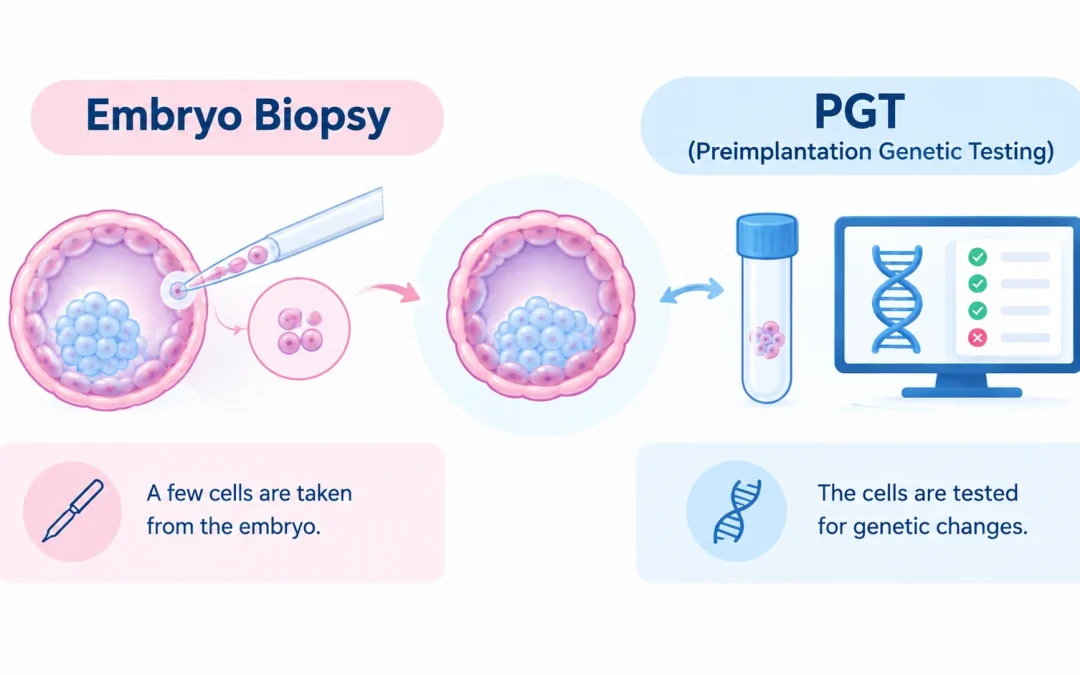
What Is Embryo Biopsy, and How Is It Different From PGT?
| Term | Meaning |
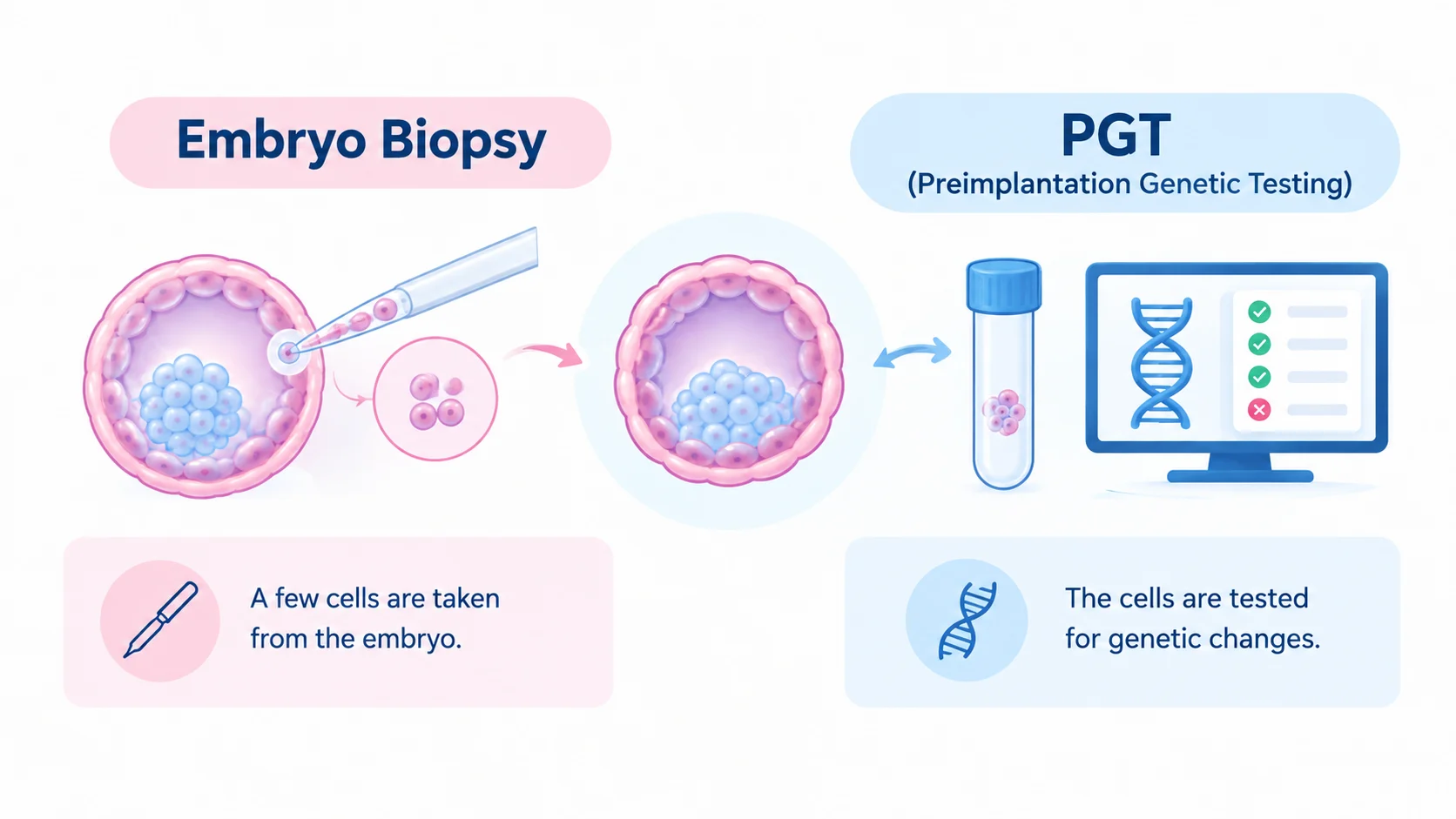
| Embryo biopsy | The physical step: taking a few cells from the embryo |
| PGT (preimplantation genetic testing) | The genetic analysis done on those cells |
| Trophectoderm biopsy | Biopsy at the blastocyst stage (day 5–6); now the method of choice in many centres |
Older methods took a cell from a day-3 embryo. ACOG notes that day-3 biopsy appears to reduce implantation potential, and a single cell also can’t be re-checked. That is why the field moved to blastocyst biopsy.
Quick Answer
- What it is: Removal of a small sample of cells from a blastocyst for genetic testing.
- Which cells: Cells from the trophectoderm, the outer layer that becomes the placenta, not the cells that become the baby.
- What it’s for: PGT-A (chromosome count), PGT-M (a known single-gene condition), or PGT-SR (structural chromosome changes).
- Who may consider it: Couples with a known inherited condition or chromosome rearrangement, and, case by case, those with recurrent pregnancy loss, repeated implantation failure, or advanced maternal age.
- Main limits: It can give unclear or “mosaic” results, adds cost and a freeze step, and has not been shown to raise the overall live birth rate per IVF cycle for every patient.
- Where to discuss it in Pune: An IVF specialist in Pune can tell you if it fits your history.
Types of PGT
| Type | Checks for | Typical use |
| PGT-A | Extra or missing chromosomes (aneuploidy) | Selecting embryos with a normal chromosome count, case by case |
| PGT-M | One specific inherited gene condition | Parents who carry a known genetic disease |
| PGT-SR | Structural chromosome rearrangements | A parent with a balanced translocation |
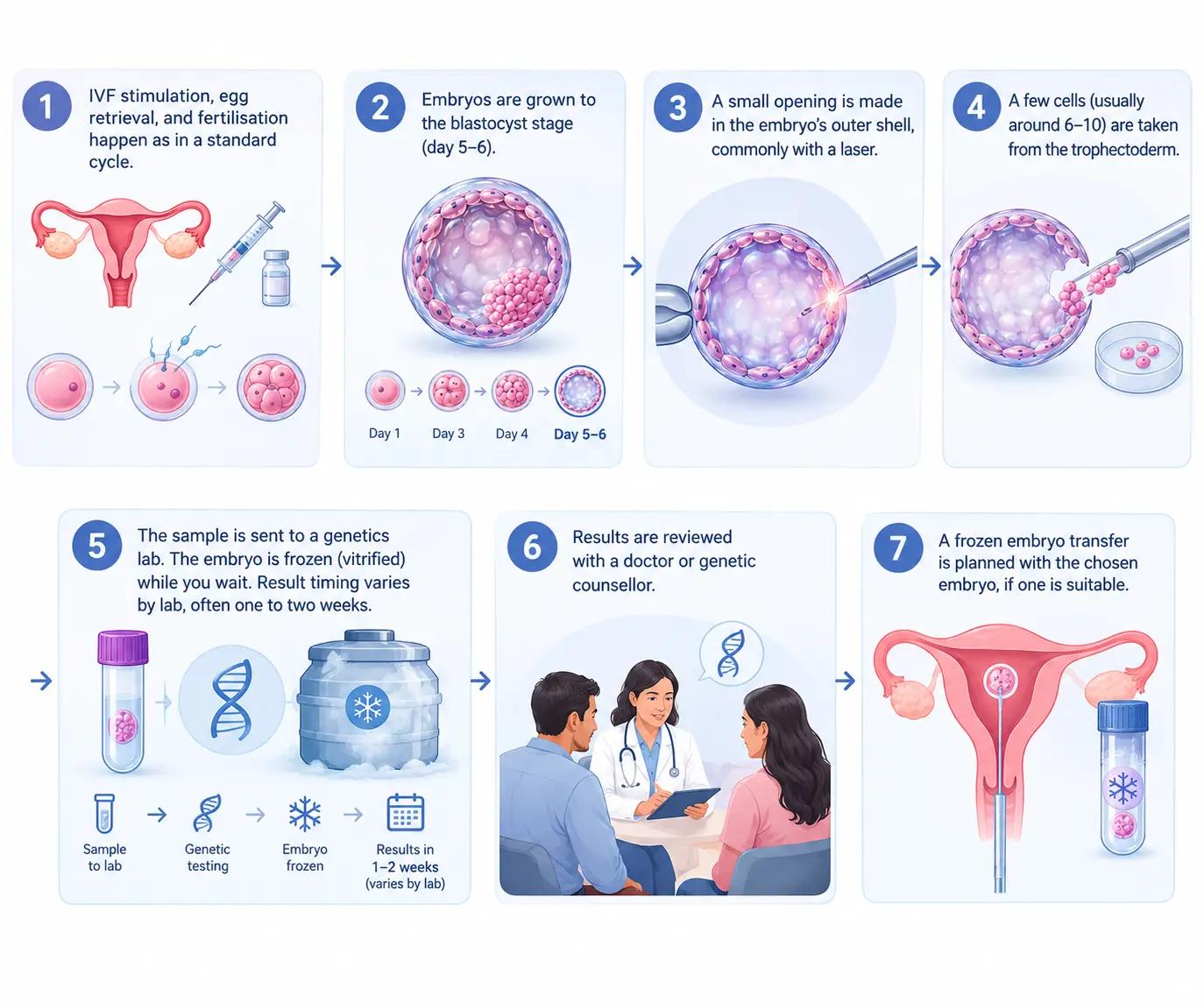
How the Procedure Works (Step by Step )
- IVF stimulation, egg retrieval, and fertilisation happen as in a standard cycle.
- Embryos are grown to the blastocyst stage (day 5–6).
- A small opening is made in the embryo’s outer shell, commonly with a laser.
- A few cells (usually around 6–10) are taken from the trophectoderm.
- The sample is sent to a genetics lab. The embryo is frozen (vitrified) while you wait. Result timing varies by lab, often one to two weeks.
- Results are reviewed with a doctor or genetic counsellor.
- A frozen embryo transfer is planned with the chosen embryo, if one is suitable.
Benefits vs Risks
| Possible Benefits | Risks and Limitations |
| Can avoid transferring an embryo carrying a known inherited condition (PGT-M) | A small theoretical risk of embryo damage from the biopsy itself |
| Can help identify chromosomally normal embryos, which may help some patients avoid repeat failed transfers | The result can be “no result” or unclear; one trial description cites inconclusive results in roughly 2–6% of trophectoderm biopsies |
| May give couples with a family genetic history more certainty | The sample comes from the placenta-side cells, so it may not reflect the whole embryo |
| Can shape the order in which embryos are transferred | Mosaic results are hard to interpret; some mosaic embryos still lead to healthy babies |
| Adds cost and a freeze-all step | |
| ASRM (2024) states its value as a routine screening test has not been demonstrated |
What Does the Evidence Say About Success?
- A biopsy result is a probability tool, not a promise. A normal result doesn’t guarantee implantation or a healthy baby.
- ASRM’s 2024 opinion says PGT-A’s value as a routine screening test hasn’t been demonstrated, and that patients should be counselled about possible outcomes such as no result, mosaicism, or misdiagnosis before testing.
- PGT-A can help choose between embryos you already have. It doesn’t create better embryos or add embryos.
Mosaic embryos can implant and produce apparently healthy babies, though ASRM notes success may be lower. Because mosaic reports depend on the lab platform and cut-offs, they are debated. This is an evolving area, so ask how your lab reports mosaicism.
Who May Consider Embryo Biopsy?
| Situation | Is PGT commonly discussed? |
| Known inherited single-gene condition in the family | Yes (PGT-M) |
| A parent with a balanced chromosome translocation | Yes (PGT-SR) |
| Recurrent pregnancy loss | Sometimes, after a full work-up |
| Repeated implantation failure with good-graded embryos | Sometimes, along with other tests |
| Advanced maternal age | Case by case; evidence for benefit is mixed |
| Only one or two embryos | Often less useful; discuss openly |
Embryo grade alone doesn’t show chromosomes. See our guide to the blastocyst grading scale for what grades like 4AA do and don’t tell you.
Is Embryo Biopsy Legal in India? What About Gender?
- India permits PGT to screen for genetic disease only. The ART (Regulation) Act 2021 restricts PGT to screening for known genetic conditions and prohibits “designer baby” uses.
- Sex selection is prohibited under the PCPNDT Act 1994 and the ART Act, except in the narrow medical case of preventing a serious sex-linked disorder.
- Clinics performing embryo biopsies are expected to be registered under the PCPNDT Act. Ask to see registration if you want reassurance.
- Any clinic promising gender selection is a red flag.
What Affects Embryo Biopsy Cost in Pune?
We are not quoting a fixed figure, because prices vary by lab, test type, and number of embryos. What usually shapes the total:
| Cost Factor | Why It Matters |
| Type of test (PGT-A, PGT-M, PGT-SR) | PGT-M often needs a custom family-specific set-up, which can change cost and time |
| Number of embryos biopsied | Testing is often charged per embryo; confirm with your clinic |
| Lab used | Different labs and platforms price differently |
| Freezing and storage | Embryos are frozen while awaiting results |
| Frozen embryo transfer cycle | Transfer usually happens in a later cycle |
| Genetic counselling | Recommended before and after testing |
Ask for an itemised written quote that separates biopsy, testing per embryo, freezing, and transfer, so you can compare fairly.
When to Talk to a Specialist
- You’ve had two or more pregnancy losses or several failed transfers.
- You or your partner carry a known genetic condition or chromosome rearrangement.
- You’re unsure whether testing suits your age and embryo number.
- You want a second opinion on a “mosaic” or unclear result.
To discuss your history in Pune, you can book a consultation with Dr. Supriya Puranik.
Recent Research and Updates
- Mosaicism guidance: ASRM’s 2023 committee opinion says mosaic embryos may be considered for transfer after counselling, with prenatal diagnosis discussed. Research continues on whether mosaic reports truly reflect the whole embryo.
- Non-invasive PGT: Studies are testing DNA released into the culture medium (niPGT-A) as a no-biopsy option. In one pilot cited in a trial registry, results matched trophectoderm biopsy in 84% of samples. This is still experimental and not a standard replacement.
Is embryo biopsy painful or harmful to the embryo?
How many cells are removed?
Does embryo biopsy increase IVF success?
How long do results take?
Can a biopsied embryo be transferred fresh?
What does a mosaic result mean?
Can embryo biopsy tell me my baby's gender?
Is PGT-A necessary for everyone doing IVF?
Can a biopsy give no result?
Is embryo biopsy safe for the baby?

-
About Author
Dr. Supriya Puranik
Gynaecologist & IVF Specialist
MMC -072514 (1993)
Dr. Supriya Puranik, a renowned gynaecologist and infertility expert, leads the IVF & Gynaecology department at Sahyadri Hospitals Momstory in Shivaji Nagar, Pune. She is committed to helping couples overcome infertility challenges.